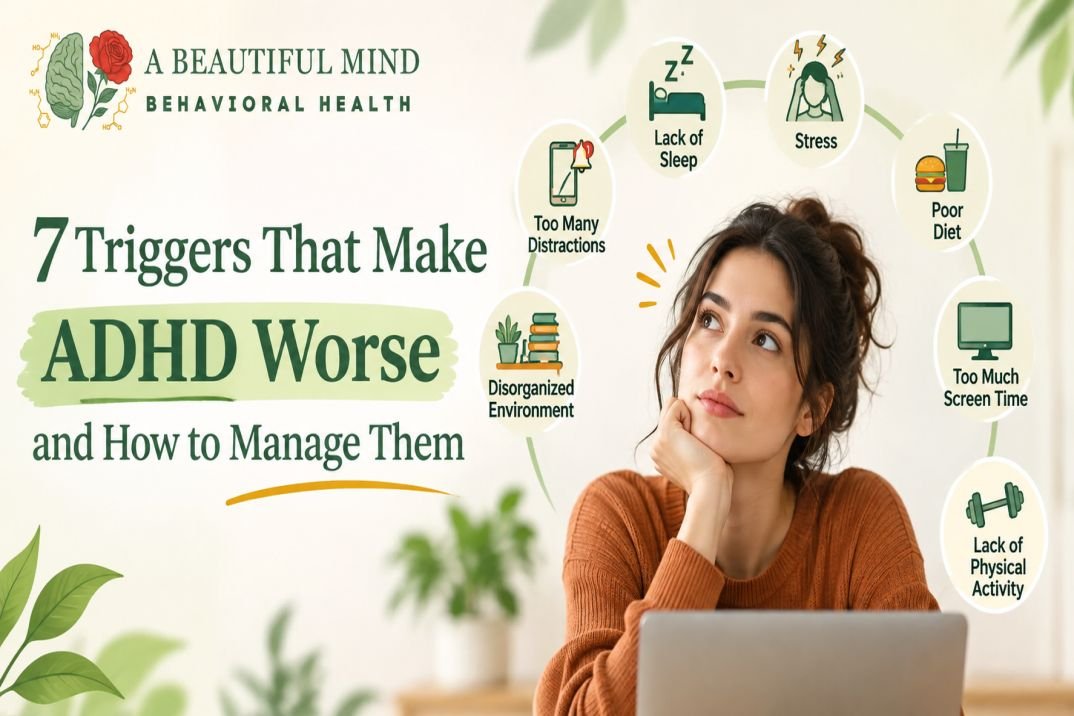
Poor sleep, chronic stress, digital overload, no routine, alcohol, irregular eating with little movement, and untreated anxiety, depression, or hormone changes are the seven biggest triggers that make ADHD worse. None of them cause ADHD. What they do is take a brain that already works harder to focus and manage emotions and make that job tougher. It’s why the same person can handle a Tuesday just fine and then struggle badly on Friday, after a week of broken sleep and a looming deadline.
What does it mean when something makes ADHD worse?
A trigger is anything that turns existing symptoms up. Your ADHD hasn’t changed. Your forgetfulness gets louder, your patience gets shorter, and a to-do list that felt manageable last week suddenly doesn’t.
Triggers also differ from person to person, so treat the list below as a starting point and not a rulebook.
The 7 Triggers That Make ADHD Worse
1. Poor sleep and a late body clock
Sleep has the strongest evidence behind it, and it’s usually the first place to look. Short sleep chips away at focus, memory, and emotional control. Those are the exact skills ADHD already makes harder.
Here’s the catch. Many people with ADHD don’t just sleep badly. Their body clock runs late. Between 73% and 78% of children and adults with ADHD fall asleep and wake up later than normal. In one 2020 study, about 67% of adults with ADHD also had insomnia, compared with roughly 30% of adults without ADHD.
Researchers have also tested what a lost night does. In a Biological Psychiatry study of 180 adults, people who went without sleep did worse on cognitive tests. Those with high ADHD traits did worst, especially on tasks that needed emotional control.
Sometimes the problem isn’t habits at all. Untreated sleep apnea can look a lot like ADHD, with poor focus, irritability, and trouble organizing. If your symptoms got worse even though you seem to be sleeping enough, ask a clinician about a sleep study.
For a start, pick one wake time and stick to it, even on weekends. Dim the lights an hour or two before bed and keep your phone out of the bedroom. Some trials have tested low-dose melatonin, but check with your clinician before trying it.
2. Chronic stress and emotional overload
Stress uses the same mental energy that ADHD already drains. When the two compete, forgetfulness, disorganization, and restlessness get worse, and small frustrations can turn into outbursts. Deadlines, conflict, and criticism are the usual culprits, especially when they pile up.
You can’t remove stress, but you can shrink it. Break big tasks into pieces small enough to start in five minutes, and put reminders where you’ll actually see them. Therapy that teaches emotional regulation, such as CBT or DBT, gives you tools for the moments when a planner isn’t enough.
3. Digital overload and constant notifications
Every ping is a small invitation to drop what you’re doing. With ADHD, that invitation is hard to ignore, and every switch makes it harder to get back on track. Social media apps are built to hold your attention, which doesn’t help.
The research is real but modest. A 2018 JAMA study followed 2,587 teens who started without significant ADHD symptoms. Among those who used seven digital activities at a high frequency, 9.5% later showed ADHD symptoms, compared with 4.6% of those who used none. The authors were clear that this doesn’t prove digital media causes ADHD. A newer analysis of 11,286 adolescents found that compulsive use, rather than hours spent, predicted small increases in symptoms the following year.
Silence the notifications you don’t need and keep your phone out of reach during focused work. Pay attention to scrolling you can’t seem to stop, because that’s the pattern the newer research points to.
4. Lack of routine and structure
ADHD makes planning and sequencing harder, so a predictable routine does some of that work for you. Clinicians often suggest tying a habit to something you already do, like taking your medication right after brushing your teeth.
Open, unstructured time is often the hardest part. People who work from home, or whose schedules suddenly change, tend to notice symptoms getting worse because nothing outside them provides structure. Try anchoring your day with three fixed points: when you wake up, when you start your first task, and when you wind down at night. Stay flexible in between.
5. Alcohol and other substances
A drink can feel like it takes the edge off restlessness. It does, briefly. Over time, drinking makes ADHD symptoms harder to manage, and it wrecks sleep, which loops you right back to the first trigger.
If you take medication, alcohol adds risk. Drinking with stimulant medication raises the chance of side effects and alcohol poisoning, and it can make some extended-release stimulants, such as Ritalin LA, release faster than intended. The details depend on your medication, so ask your prescriber what applies to you.
Caffeine is a different story. On its own it doesn’t change ADHD symptoms much, but it can interact with ADHD medications, and an afternoon coffee can push your bedtime later. A cutoff six to eight hours before bed is a reasonable rule.
6. Irregular eating and low physical activity
Skipped meals leave you tired, irritable, and foggy. That combination feels exactly like ADHD getting worse, even when food is the real issue.
The evidence here is weaker than it is for sleep, and it’s worth saying so. Researchers haven’t pinned down which foods or additives, if any, trigger ADHD in a particular person. Movement has a clearer payoff. Exercise burns off restlessness, and energy you don’t use during the day can show up as a restless mind at night. Eat at regular times, include some protein, and move in a way you actually enjoy.
7. Untreated anxiety, depression, and hormonal changes
ADHD rarely shows up alone. In a 2022 study of 353 adults with ADHD, nearly half also had an anxiety disorder. When anxiety or depression goes untreated, ADHD symptoms tend to get worse too, and it becomes hard to tell which one is driving what.
Hormones can play a part as well. Hormonal shifts can worsen ADHD and sometimes unmask ADHD that was never diagnosed. Perimenopausal women are now one of the largest groups seeking a diagnosis. If any of this sounds familiar, the right move is to treat the co-occurring condition directly and ask whether your ADHD treatment needs adjusting.
Why did my ADHD suddenly get worse?
A sudden change almost always points to something that shifted around you. The usual suspects are new stress, disrupted sleep, a medication change or missed doses, more alcohol than usual, a hormonal shift, or anxiety or depression that has gone untreated. Sleep apnea is worth ruling out too. ADHD doesn’t normally jump in severity without a reason, so a sudden change deserves a closer look.
Do sugar and screens really make ADHD worse?
Screens can contribute, mostly through distraction and lost sleep, though the research shows only modest links. Sugar is murkier. Researchers haven’t shown that sugar causes ADHD or reliably worsens it, and the link between specific food additives and symptoms is still unclear for individual people. Blood sugar swings can still leave you tired and irritable, so regular meals are a sound habit either way.
How do you find your personal triggers?
A two-week log works better than guessing. Each day, jot down your sleep hours, caffeine and alcohol, stress level, screen time, meals, and exercise, plus a one to five rating for focus and mood. Patterns often show up within a few days. If nothing stands out, or if symptoms stay severe, bring the log to a clinician.
When should you talk to a professional?
Reach out if your symptoms interfere with work, school, or relationships, if they got worse suddenly, or if you’re using alcohol or other substances to cope. This article gives general information and isn’t a diagnosis. A qualified clinician can evaluate your symptoms, rule out other causes, and adjust your treatment. Please don’t stop or change ADHD medication without talking to your prescriber first.
What to do next
Poor sleep, stress, digital overload, no routine, alcohol, irregular eating, and untreated co-occurring conditions are the seven main triggers that make ADHD worse. Start with sleep, since it has the strongest evidence and affects everything else. Then track your own patterns for two weeks and see what stands out.
If you’d like professional support, A Beautiful Mind Behavioral Health offers online ADHD therapy, psychiatric evaluations, and medication management with Mrs. Faridah Mumin, PMHNP-C, FNP-C, for adults across California. You can call +1 213-762-0238 to ask about a free consultation.