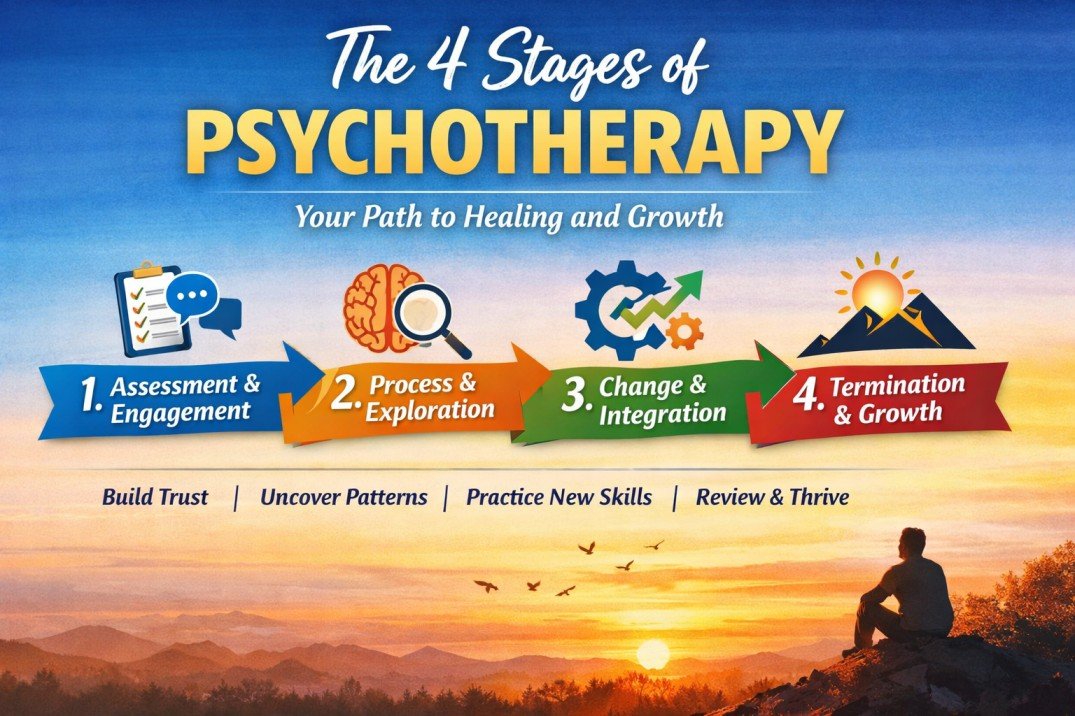
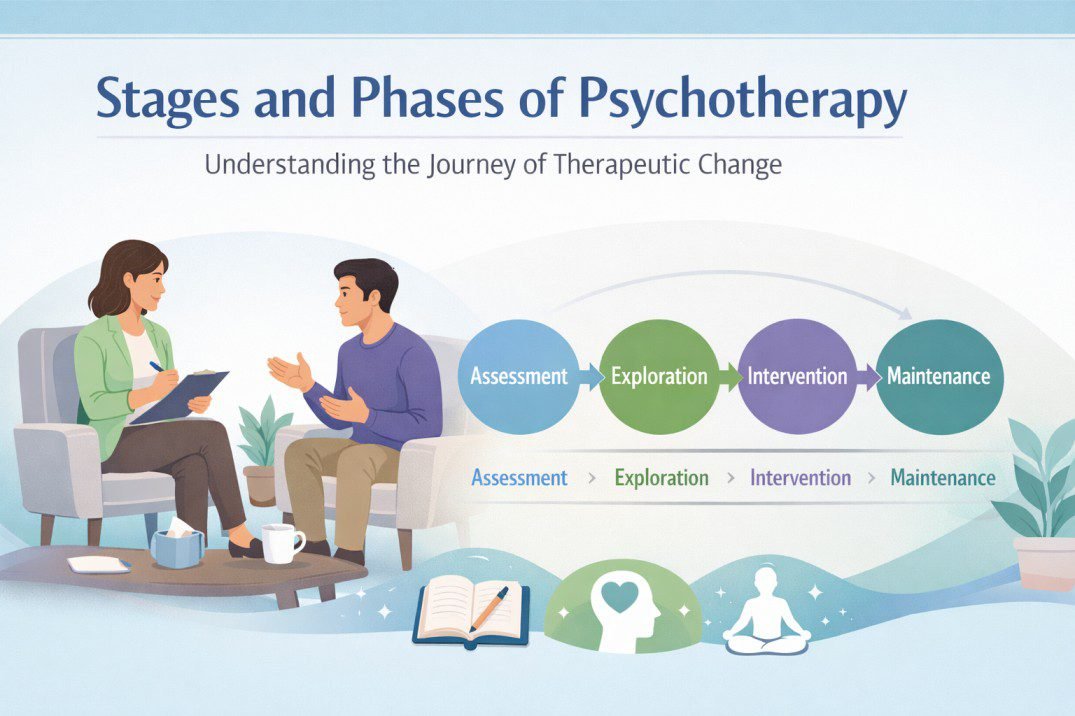
Psychotherapy follows four to seven stages depending on the model you use. You start with assessment and rapport building in psychotherapy, where trust forms between you and your therapist. You move on to exploring issues and patterns that influence your thoughts and behavior. You apply interventions for change as psychotherapy progresses through structured techniques and therapeutic work. You end with termination and maintenance. Models like the standard four-stage process, the PROCESS seven steps, or Rogers’ seven stages all cover these elements with slight variations. Expect overlap and nonlinearity. Therapy adapts to your needs.
What Are the Core Stages of Psychotherapy?
Therapists structure sessions into phases to guide progress. You enter therapy with uncertainty. The first stage builds trust through assessment. Your therapist asks about your history, symptoms, and goals. You discuss confidentiality and expectations. This phase lasts one to three sessions. It sets the foundation.
In the second stage, you explore deeper. You identify negative patterns like avoidance or rumination. Your therapist helps you uncover emotions and triggers. Resistance often surfaces here. You push through it by examining thoughts and behaviors. This working phase spans five to twenty sessions.
The third stage focuses on action. You learn skills from CBT, DBT, or other methods. You practice homework, like journaling or behavioral experiments. Change happens as vicious cycles break into virtuous ones. You see shifts in mood, relationships, or habits.
The final stage prepares you for independence. You review gains, plan for relapse, and address ending the relationship. This termination phase takes one to four sessions. You leave with tools for resilience.
Therapy rarely follows a straight line. You revisit earlier stages if life stresses hit. Personalization matters. Your therapist tailors phases to your issues, like trauma or anxiety.
Standard 4-5 Stage Model Explained
Most therapies use this framework. It matches sources like Psychology Today and Energetics Institute.
You begin in the initial phase. Your therapist conducts intake. You share background and set measurable goals. Trust forms through empathy and active listening. Research shows this alliance predicts 30 percent of outcomes.
Next comes exploration. You delve into patterns. Your therapist spots repetitions, like self-criticism fueling depression. You build awareness.
Intervention follows. You apply techniques. For anxiety, you challenge catastrophic thoughts. You rehearse responses.
Maintenance closes it. You consolidate skills. Your therapist helps you predict hurdles and prescribe counters, like deliberate exposure to fears.
Some add a fifth pre-phase: contemplation. You weigh readiness before committing.
| Stage | Focus | Typical Duration | Your Actions |
| 1. Initial | Rapport, assessment | 1-3 sessions | Share history openly |
| 2. Exploration | Patterns, emotions | 5-20 sessions | Track triggers |
| 3. Intervention | Skills, change | Varies by need | Complete homework |
| 4. Termination | Review, plan | 1-4 sessions | Practice independence |
| 5. Contemplation | Readiness | Pre-therapy | Reflect on motivation |
The 7-Step PROCESS Model
Psychology Today outlines seven steps common to effective therapies. J. Scott Fraser developed this from research on common factors.
Phase one pairs you with your therapist. Empathy, genuineness, and goal consensus build alliance. You feel hope.
Phase two recognizes patterns. Your therapist maps vicious cycles. You define problems and past attempts.
Phase three orients toward change. You agree on targets, like shifting depression loops.
Phase four collaborates on plans. You align on rationale, whether cognitive or relational.
Phase five engages treatment. Interventions start immediately. You enact dialogues or question beliefs.
Phase six supports success. Your therapist affirms ownership of gains. You view changes as personal strengths.
Phase seven sustains them. You predict relapses and rehearse. Booster sessions remain open.
This model unifies approaches. It emphasizes cycles over linear steps.
Rogers’ 7 Stages and Other Models
Carl Rogers described seven internal stages for client-centered therapy. You start rigid and defensive. You move to awareness of feelings. You experience them fully. You gain insight into conditions of worth. You value yourself unconditionally. You integrate changes. You actualize potential.
Energetics Institute lists four: commitment, process, change, termination.
Integrative models add five: contemplation, preparation, action, maintenance, contemplation relapse.
Compare them directly.
| Model | Key Phases | Strengths |
| PROCESS (7) | Pairing to sustaining | Breaks cycles universally |
| Rogers (7) | Rigidity to actualization | Client-driven growth |
| Energetics (4) | Commitment to termination | Simple overview |
| Integrative (5) | Contemplation to maintenance | Behavior change focus |
Choose based on your style. Client-centered suits introspection. PROCESS fits structured goals.
Common Challenges in Each Phase
Resistance hits hardest in exploration. You avoid painful truths. Your therapist normalizes it and uses empathy to proceed.
Transference emerges when you project past feelings onto the therapist. They address it directly.
Termination stirs loss. You manage it by focusing on gains.
Non-linearity frustrates. Life events pull you back. View it as normal adaptation.
Factors That Make Therapy Work
Alliance drives success more than technique. Set clear goals early.
Personalize interventions. CBT suits anxiety. Psychodynamic fits relational issues.
Engage actively. Homework doubles results.
Timelines vary. Brief therapy takes eight to twelve sessions for skills. Deeper work spans months.
| Success Factor | How It Works | Evidence |
| Therapeutic alliance | Builds trust | 30% outcome variance |
| Clear goals | Guides focus | Improves retention |
| Client engagement | Applies learning | Boosts long-term change |
| Flexibility | Handles setbacks | Matches real life |
How Long Do Phases Last?
Initial phase: one to three sessions.
Exploration and intervention: weeks to years, based on issue severity and engagement.
Termination: brief but intentional.
Total therapy averages twelve to twenty sessions, per studies. Complex trauma extends it.
You decide pace with your therapist.
Signs You’re Ready to Advance Phases
From initial to exploration: You trust enough to share vulnerabilities.
To intervention: You identify patterns clearly.
To termination: You maintain skills independently for weeks. You handle stressors without crisis.
Discuss openly. No rush.
FAQs
How does the PROCESS model differ from standard stages?
PROCESS details seven steps across therapies, emphasizing pattern shifts. Standard stages group them into four broader buckets.
Is psychotherapy always linear?
No. You loop back as needed. Real life demands flexibility.
What if I face resistance?
Expect it in exploration. Your therapist guides you through with validation and gentle challenges.
How do I prepare for termination?
Review goals met. Build a relapse plan. Schedule boosters if wanted.
Which model fits beginners?
Start with four stages for simplicity. Add PROCESS for depth.
Can phases overlap?
Yes. Assessment continues subtly throughout.
Conclusion
Psychotherapy works through structured stages that guide you from understanding your concerns to building lasting change. A strong therapeutic alliance, your motivation to engage in the process, and a treatment approach that fits your needs all influence therapy success. Progress often develops gradually as you recognize patterns, apply new coping strategies, and strengthen emotional resilience.
Understanding the stages and phases of psychotherapy helps you approach therapy with realistic expectations and confidence. If you are considering professional support, A Beautiful Mind Behavioral Health provides guidance through each stage of the therapeutic process with personalized care designed to support your long term mental well being.